Which Features Make Inventory Software Useful for Growing Businesses?
Investing in the right inventory software does more than just organize your warehouse—it lays the operational foundation for sustainable growth. Read our full Blog for more Information!
Transitioning from a spreadsheet-based tracking system to dedicated inventory management software is a major milestone. For a growing business, manual errors, stockouts, and inaccurate counts quickly eat into profit margins and strain customer trust.
However, not all inventory solutions are created equal. To scale efficiently, growing enterprises need software packed with specific capabilities designed to handle complexity, automation, and real-time visibility.
Real-Time Inventory Tracking
Old-school spreadsheets require constant manual updates, leaving a dangerous, costly gap between what your system records and what physically sits on your warehouse shelves. Real-time inventory tracking bridges this gap by recording every single movement immediately. Whether an item is sold, returned, or transferred, your inventory data updates instantly across your entire network, eliminating costly human errors, reducing stock discrepancies, and giving your operations team the absolute accuracy needed to scale smoothly.
Live Updates
Live updates ensure that your stock levels reflect reality second by second. When an online customer completes a checkout or a retail cashier rings up a sale, the central database refreshes instantly. This immediate synchronization protects your business from embarrassing cancellations, maintains accurate website stock counters, and preserves customer trust effortlessly.
Barcode and RFID Integration
Barcode and RFID integration drastically speed up your fulfillment workflow while virtually eliminating manual typing errors. Instead of tedious manual counting, employees simply scan items during receiving, picking, and shipping. This seamless technology captures data in milliseconds, keeps your database pristine, and dramatically accelerates warehouse turnaround times for growing order volumes.
Multi-Channel & Omnichannel Syncing
Selling across your own e-commerce website, major online marketplaces like Amazon or eBay, and physical retail locations creates massive complexity. Without central coordination, inventory balancing becomes an operational nightmare. Robust multi-channel and omnichannel syncing connects all your sales channels into a single ecosystem. This seamless integration ensures your inventory levels automatically adjust everywhere the moment a product is sold, keeping your multi-platform retail operations efficient, accurate, and completely aligned.
Unified Dashboard
A unified dashboard gives your team instant, centralized visibility over stock across every sales channel from one convenient screen. Instead of jumping between disparate systems or logging into multiple seller portals, managers can monitor stock health, track fulfillment statuses, and evaluate cross-channel performance instantly, saving hours of manual administrative work every single week.
Overselling Prevention
Overselling damages customer trust and leads to costly marketplace penalties. Advanced inventory software prevents this by instantly updating stock counts the split second an item sells anywhere. If your last unit is purchased in-store, the system immediately blocks online buyers, protecting your reputation and eliminating embarrassing fulfillment cancellations entirely.
Automated Reordering and Low-Stock Alerts
Running out of a best-selling product leads to lost revenue and frustrated customers, while overstocking ties up valuable working capital. Automated reordering and low-stock alerts eliminate this guesswork completely. The system continuously monitors your inventory levels against sales trends and supplier lead times. It immediately triggers notifications when stocks run low and can even generate replenishment orders automatically, protecting your cash flow and ensuring you never miss a sale.
Smart Thresholds
Smart thresholds customize minimum stock levels for every individual SKU based on its specific sales velocity. Instead of a static rule, these dynamic thresholds factor in seasonal spikes and supplier lead times, ensuring your business maintains optimal buffer stock without unnecessarily tying up liquid capital in slow-moving inventory.
Automated Purchase Orders
Automated purchase orders take the tedious administrative burden out of restocking. Once an item dips below its designated threshold, the software instantly compiles and generates a complete purchase order ready for supplier approval. This speeds up replenishment cycles, eliminates manual data entry errors, and keeps your supply chain running smoothly.
Comprehensive Reporting and Analytics
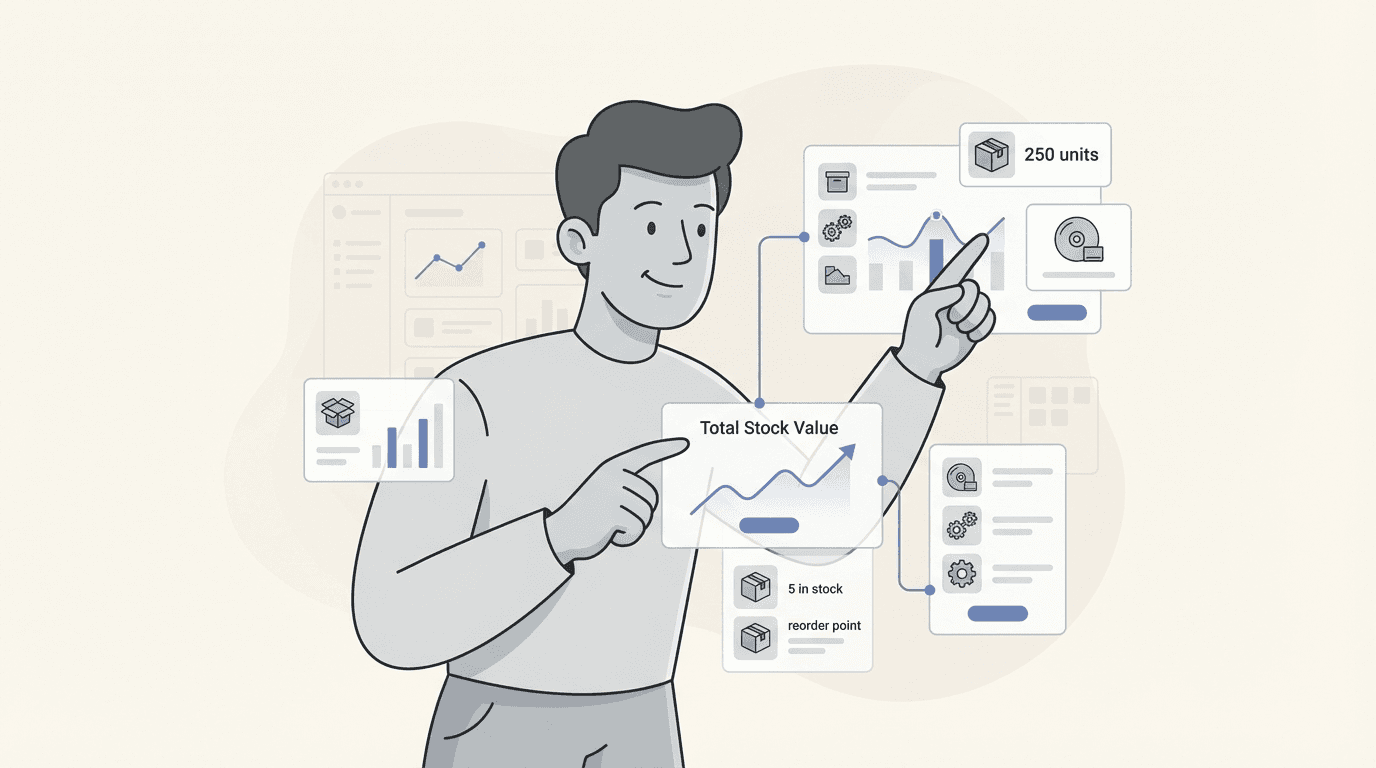
Data-driven decision-making separates thriving businesses from stagnant ones. Comprehensive reporting and analytics give you deep insight into your entire operation, revealing hidden trends, slow-moving stock, and high-profit margins. Instead of relying on guesswork, leadership teams can review crystal-clear data dashboards to optimize purchasing strategies, reduce holding costs, and make confident, strategic choices that accelerate long-term growth and maximize profitability across every single sales channel.
ABC Analysis
ABC analysis categorizes your inventory based on profitability and turnover rate. Class A items are high-value products with tight control, while Class C items represent low-value goods. This strategic classification helps growing businesses allocate capital efficiently, prioritize warehouse management resources, and prevent tied-up funds in stagnant stock.
Demand Forecasting
Demand forecasting uses historical sales data, market trends, and seasonal shifts to predict future inventory needs with high precision. By anticipating customer demand proactively, businesses avoid sudden stockouts during peak seasons, streamline supplier purchasing schedules, and maintain optimal inventory levels without unnecessary storage overhead.
Multi-Location and Warehouse Management
As your business expands, relying on a single fulfillment center becomes restrictive. You might introduce multiple regional warehouses, pop-up retail shops, or partner with third-party logistics (3PL) providers. Managing multiple sites without specialized software leads to fragmented stock and fulfillment bottlenecks. Multi-location and warehouse management features solve this by providing centralized visibility, letting you oversee inventory health across your entire supply chain seamlessly while optimizing fulfillment routes and reducing overhead costs.
Location Mapping
Location mapping brings total precision to your facility by tracking exactly which aisle, shelf, or bin holds every single item. When workers fulfill orders, the software provides optimized picking paths. This eliminates endless searching, drastically speeds up warehouse workflows, and ensures new staff can locate products immediately without friction.
Internal Transfers
Internal transfers streamline the movement of stock between different warehouses, retail storefronts, or storage hubs while maintaining absolute inventory accuracy. The system tracks items the moment they leave one location until they arrive at another, preventing lost stock, eliminating discrepancies, and ensuring balanced product availability everywhere you sell.
Essential Features & Business Benefits
Feature | Primary Benefit | Why It Matters for Growth? |
Real-Time Tracking | Accurate stock counts | Prevents costly discrepancies and stockouts. |
Multi-Channel Sync | Centralized oversight | Eliminates manual double-entry across sales platforms. |
Automated Reordering | Optimized cash flow | Frees up working capital by avoiding overstock. |
Advanced Reporting | Strategic insights | Identifies top-performing products and sales trends. |
Multi-Warehouse Support | Scalable logistics | Simplifies complex supply chains as you expand. |
Final Thoughts
Investing in the right inventory software does more than just organize your warehouse—it lays the operational foundation for sustainable growth. By automating repetitive tasks, reducing human error, and providing crystal-clear visibility, your team can spend less time putting out fires and more time scaling the business.